

Better Than Blood Pressure: Large-scale research involving over half a million people confirms that grip strength predicts mortality risk more accurately than systolic blood pressure.
A Systemic Warning Light: Your grip isn't just about hand muscles; it integrates your nervous system, metabolic health, and inflammatory levels, acting as a "dashboard light" for your overall biological age.
The Metabolic Link: Weak grip often signals insulin resistance and chronic inflammation years before standard tests catch them, revealing how well your body maintains muscle against aging.
Train the Body, Not Just the Hand: You cannot "hack" longevity by squeezing a stress ball. Improving your grip requires comprehensive resistance training that strengthens your entire physiological system.
Introduction
You extend your hand to greet someone new. That brief squeeze, firm or weak, confident or tentative—just communicated more information about your age than your driver's license ever could.
Scientists now recognise grip strength as a biomarker of aging, but that clinical term doesn't capture what's actually happening. Your grip integrates the electrical signals racing from your brain down nerve pathways, the metabolic processes powering muscle contractions, the cardiovascular system delivering oxygen to working tissue, and the inflammatory state quietly corroding or preserving all of it.
When any of these systems falters: poor nerve conduction, metabolic dysfunction, cardiovascular decline, chronic inflammation, your grip gives you away.
Discover the 5 habits that boost your longevity
Unlock a doctor-reviewed 5-day guide to the core pillars of long-term health—diet, exercise, lifestyle, sleep, and mental wellbeing. Evidence-based, practical, and designed to help you start making meaningful changes today.
No spam. Unsubscribe anytime.
By continuing, you agree to receive occasional updates from Emerald. See our Privacy Policy.
The Global Study That Changed Everything
In 2015, researchers published findings from 139,000 adults across 17 countries. They measured grip strength alongside traditional health markers, then followed these individuals over time to track health outcomes.
The results challenged conventional thinking: grip strength predicted death more powerfully than systolic blood pressure - the top number your doctor monitors closely. For every 5 kg drop in grip strength, all cause mortality risk climbed approximately 16%.
This wasn't a small study. The UK Biobank study later confirmed these findings in over half a million people. Among patients already diagnosed with coronary artery disease, each 5 kg increase in grip strength was associated with a 15% reduction in mortality risk.
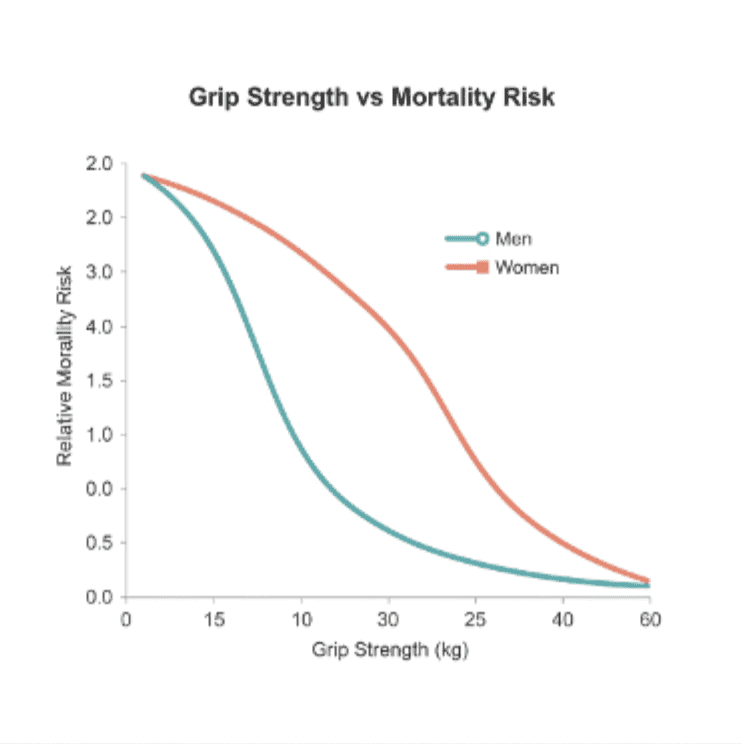
Figure 1: Mortality risk declines sharply with increasing grip strength, then plateaus beyond 40–50 kg in men and 25–30 kg in women.
Understanding What This Really Means
Here's the crucial distinction that often gets missed: grip strength doesn't directly cause you to live longer. You can't simply squeeze a stress ball daily and expect to add years to your life.
Instead, grip strength serves as a remarkably accurate window into your overall health status. Think of it as a dashboard warning light in your car, the light itself isn't the problem, but it reliably indicates when something under the hood needs attention.
When you improve grip strength through proper resistance training, you're not just strengthening your hands. Instead you're:
Building lean skeletal muscle mass throughout your body
Improving insulin sensitivity and metabolic function
Enhancing neuromuscular coordination
Reducing systemic inflammation
Strengthening bones and connective tissue
Your grip strength improves because all of these underlying systems improve. And it's these fundamental improvements that reduce mortality risk—your grip strength simply provides a convenient, measurable way to track the progress.
This is why targeted grip exercises alone won't deliver the longevity benefits shown in research. The magic lies in comprehensive strength training that improves your entire physiological system, with grip strength serving as one reliable marker of that improvement.
Longevity starts with awareness
Less than £1/day. Test 115+ biomarkers. Personalised plan and 1:1 GP support.
The VO₂max Question Everyone Asks
"Isn't VO₂max supposed to be the best predictor of longevity?"
Yes—and no.
VO₂max measures your maximal oxygen uptake during exhaustive exercise. It captures cardiovascular fitness brilliantly. Athletes obsess over it. Researchers trust it. The challenge lies in measurement: determining true VO₂max requires specialised laboratory equipment, qualified supervision, and pushing yourself to absolute physical limits.
More importantly, they reveal different dimensions of health:
VO₂max exposes how well your heart, lungs, and blood vessels deliver oxygen when maximally stressed. It's cardiovascular performance under extreme conditions.
Grip strength exposes your neuromuscular integrity, metabolic health, and functional reserve. It's your body's capacity for real-world demands, carrying groceries, catching yourself from a fall, maintaining independence at 85.
Recent research confirms both independently predict mortality. They don't cancel each other out; they complement each other. Having robust VO₂max but low grip strength? You're at risk. Strong grip but poor aerobic capacity? Also at risk.
The ideal? Both are strong.

Where Do You Stand?
If you're curious about tracking your grip strength over time, hand dynamometers are widely available and relatively affordable. This isn't essential—you can build strength without ever measuring it—but having objective data creates a tangible record of your progress over months and years.
What matters far more than any single grip strength measurement is the trajectory. Are you maintaining strength as you age? Improving it? These trends reveal whether your approach to training and recovery is working.
See Appendix A for detailed normative ranges by age and sex.
Testing every six months provides meaningful feedback without becoming obsessive. Grip strength changes gradually, making more frequent testing unnecessary.
The Metabolic Connection Nobody Talks About
Most people assume grip strength reflects only muscular strength. It doesn't.
Your metabolic state, how well you manage blood sugar and inflammation, directly determines whether you maintain or lose muscle as you age. Insulin resistance, that precursor to type 2 diabetes affecting millions who don't realise it, actively degrades muscle tissue while promoting fat accumulation.
High blood sugar glycates proteins in your skeletal muscle fibers, stiffening them like leather left in the sun. Chronic inflammation activates pathways that break down muscle faster than you can rebuild it. Decreased grip strength often signals these metabolic problems years before conventional blood tests flag anything concerning.
This is why grip strength appears in cardiovascular risk prediction models. Cardiologists wouldn't typically focus on your handshake strength, but they recognise that weak grip exposes the metabolic dysfunction that's simultaneously hardening your arteries.
Building Strength That Actually Matters
Your grip strength reflects whole-body neuromuscular capacity, which means building it requires more than isolated hand exercises. The most effective approach focuses on comprehensive strength development through diverse movement patterns.
The Foundation: Functional Movement
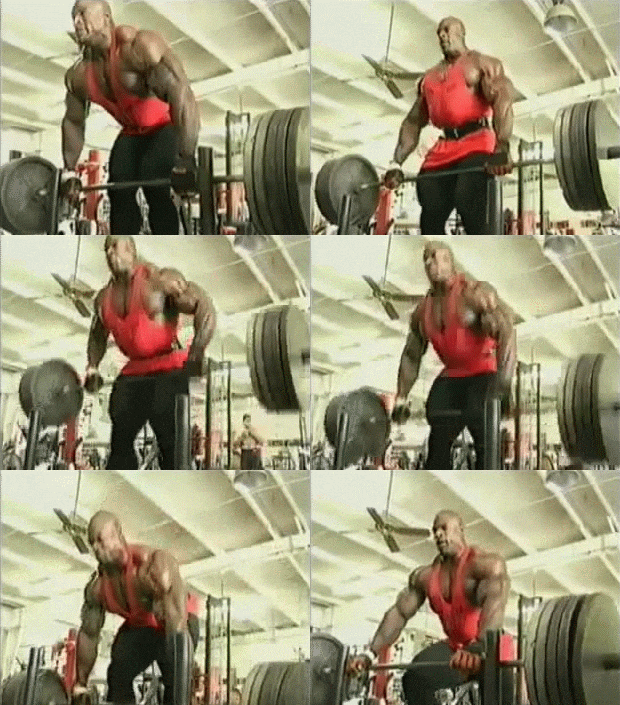
Resistance training forms the cornerstone of any effective program. Compound movements that challenge multiple muscle groups simultaneously, deadlifts, squats, presses, and rows, build the integrated strength that translates to real-world capacity. Proper form is essential; these movements require instruction and progressive loading under supervision if you're new to them.
Pilates and controlled movement practices develop the neuromuscular control that underpins strength. The precision required in these disciplines builds mind-muscle connection and joint stability, foundations that allow you to safely handle heavier loads as you progress.
Carrying exercises might be the most directly applicable to daily life. Farmer's carries, suitcase carries, and overhead carries demand sustained grip endurance while building practical upper body strength. You're literally practicing what you need for carrying shopping bags, luggage, or grandchildren.
Bodyweight pulling movements, pull-ups, rows, hangs from a pull up bar, create sustained tension through your hands and forearms while building the pulling strength that deteriorates fastest with age. These movements build grip strength as a natural consequence of the exercise rather than through isolation.
The key principle: grip strength is an output, not an input. You don't focus narrowly on grip exercises and expect comprehensive benefits. Instead, you build overall strength through diverse training, and your grip strength improves as a measurable marker of that progress.
The Recovery Equation
Training creates the stimulus for adaptation. Recovery allows that adaptation to occur. Neglect recovery and you simply accumulate damage without improvement. Your tendons, particularly in hands and forearms, can develop stubborn overuse issues if you ignore early warning signs. Protein intake provides the building blocks for repair and growth. Target 1.6-2.0 grams per kilogram of body weight daily. Sleep is when the actual rebuilding happens. Seven to nine hours of quality sleep supports recovery from training stress. Stress management isn't optional when you're training. Chronic stress elevates cortisol, which actively breaks down muscle tissue and impairs recovery.
What Weak Grip Strength Actually Reveals
Statistical associations show that low grip strength in middle age correlates with three key outcomes:
Faster progression to frailty and loss of independence
Increased cardiovascular mortality even after controlling for traditional risk factors
Greater disability in performing daily activities
But statistics describe populations, not individuals. Your grip strength today provides information about where you stand and which systems might benefit from attention. That's actionable intelligence.
The encouraging reality? Grip strength responds to intervention. Unlike many health markers largely determined by genetics or irreversible damage, you can improve your grip strength at virtually any age through appropriate training, and that improvement reflects genuine enhancement of the underlying systems it represents.

Addressing What Actually Matters
Grip strength reveals the state of your underlying health, your metabolic function, inflammatory status, neuromuscular integrity, and cardiovascular resilience. These are the systems that determine how well you age.
Emerald's comprehensive testing addresses these fundamental systems directly, measuring metabolic markers, inflammatory indicators, and hormone panels that reveal why your body is aging the way it is. Because while grip strength shows you the outcome, detailed biomarker analysis shows you the mechanisms you can actually influence.
Strong grip strength reflects good metabolic health, controlled inflammation, and robust muscle strength function. Rather than focusing on the output measure, Emerald helps you optimise the inputs, the blood sugar control, the inflammatory balance, the hormone optimisation, and the nutritional status that allow your body to build and maintain strength naturally.
Your action point is simple: start resistance training consistently while understanding your metabolic baseline. Grip strength will improve as a natural consequence when you address the underlying systems properly.
References
Bohannon RW. Grip Strength: An Indispensable Biomarker for Older Adults. Clinical Interventions in Aging, 2019;14:1681–1691.
Leong DP, Teo KK, et al. Prognostic Value of Grip Strength: Findings from the Prospective Urban Rural Epidemiology (PURE) Study. The Lancet, 2015;386(9990):266–273.
Celis-Morales CA, Lyall DM, et al. Associations of Handgrip Strength with All-Cause and Cause-Specific Mortality in 502,293 UK Biobank Participants. Age and Ageing, 2022;51(5):afac117.
Gubelmann C, Vollenweider P, Marques-Vidal P. Usefulness of Handgrip Strength to Predict Mortality in Patients With Coronary Artery Disease. The American Journal of Cardiology, 2020;125(8):1186–1193.
Silventoinen K, Tynelius P, Rasmussen F. Thresholds of Handgrip Strength for All-Cause, Cancer, and Cardiovascular Mortality: A Dose-Response Meta-Analysis. Nutrition, Metabolism and Cardiovascular Diseases, 2022;32(12):2488–2496.
Ross R, Blair SN, Arena R, et al. Cardiorespiratory Fitness: A Clinical Vital Sign. Circulation, 2016;134(24):e653–e699.
Volaklis KA, Halle M, Meisinger C. Association Between Grip Strength and Cardiorespiratory Fitness with Mortality in Older Adults: Results from the KORA-Age Study. European Journal of Preventive Cardiology, 2022;29(7):1088–1099.
García-Hermoso A, Ramírez-Vélez R, et al. Relative Handgrip Strength Improves Cardiovascular Risk Prediction: A 10-Year Cohort Study. European Journal of Preventive Cardiology, 2021;28(11):1242–1249.
Dodds RM, Syddall HE, Cooper R, et al. Grip Strength Across the Life Course: Normative Data from Twelve British Studies. PLoS ONE, 2014;9(12):e113637.
Appendix A: Normative Grip Strength Values
Age group (years) | Men – Average (kg) | Women – Average (kg) | Low Strength Cut-off (kg) (Men / Women) |
20–29 | 40–50 | 28–30 | < 27 / < 16 |
30–39 | 49–51 | 30–31 | < 27 / < 16 |
40–49 | 47–50 | 29–31 | < 27 / < 16 |
50–59 | 45–48 | 27–29 | < 27 / < 16 |
60–69 | 41–45 | 24–27 | < 27 / < 16 |
70–79 | 35–39 | 21–24 | < 27 / < 16 |
80+ | 25–32 | 14–19 | < 27 / < 16 |
Source: Dodds RM et al., PLoS ONE 2014; 9(12): e113637
Interpreting Your Results
Within average range: You're tracking along a typical aging curve for your age and sex.
Above average: You're building a functional reserve that will serve you well as you continue aging.
Below low-strength cut-off: Research indicates increased risk. This suggests focused strength training could significantly benefit your long-term health.
Most important: Track your trajectory over time. Six-month testing intervals reveal whether you're maintaining, improving, or declining faster than expected.

Test 115+ biomarkers for fine-tuning your health
See your results in 3 days with high-level accuracy and a certified GP-reviewed action plan